In today’s global agri‑industrial landscape, designing a profitable Agropark is no longer just about planning agricultural infrastructure. Major investors now understand that the real competitive edge begins long before concrete is poured or steel is erected. It starts with the business model.
A modern Agropark is conceived as a fully integrated agri‑industrial investment platform, where every technical decision aligns with financial, operational, and commercial logic. That’s why, when we talk about designing an Agropark, the key question isn’t which greenhouses to install—it’s which market you aim to serve, with what production strategy, and under what cost structure.
The initial vision sets the tone for the entire project. Before drafting an Agropark master plan, it’s essential to define its strategic positioning: Will it target export markets? Local supply? High‑value premium crops such as berries, tomatoes, or leafy greens? Or intensive production in extreme climates? This strategic definition determines the optimal size, the type of greenhouses required, the level of technology, and the structure of shared services. A mistake at this stage can compromise profitability for decades.
A second critical step in designing an agri‑industrial park is a thorough site analysis. Climate dictates structural choices, ventilation systems, and cooling or heating requirements. Water availability and quality determine the need for treatment, desalination, or reverse osmosis. Soil quality may be secondary in hydroponic systems, but it still affects drainage and structural stability. Logistics—proximity to ports, highways, or airports—directly impacts competitiveness. And closeness to consumer markets reduces distribution costs and lead times. Without this comprehensive assessment, there is no truly optimized Agropark infrastructure.
At the same time, the project must be grounded in a rigorous technical and financial feasibility study. Assessing potential demand, projecting realistic revenues, calculating initial CAPEX, and estimating operational OPEX are essential to ensure the expected return. Investors seek agri‑industrial assets that offer predictability, scalability, and risk control. A well‑designed Agropark incorporates phased growth scenarios from the outset, allowing production area expansion without disrupting structural efficiency or inflating indirect costs.
Defining the production model completes this first strategic phase. Selecting the right greenhouse types—tall gothic structures, high‑tech multitunnels, or advanced climate‑controlled systems—depends on the target crop and the profile of the operators who will settle in the park. Designing for hydroponic export tomatoes is not the same as designing for intensive strawberry or leafy‑green production. Each crop demands specific climate, energy, water, and logistics parameters.
Ultimately, designing an Agropark from scratch means aligning market strategy, engineering, and finance under a single, coherent vision. Only then does the project transcend a collection of infrastructures and become a true agri‑industrial platform capable of attracting investment, operators, and long‑term sustainable growth.
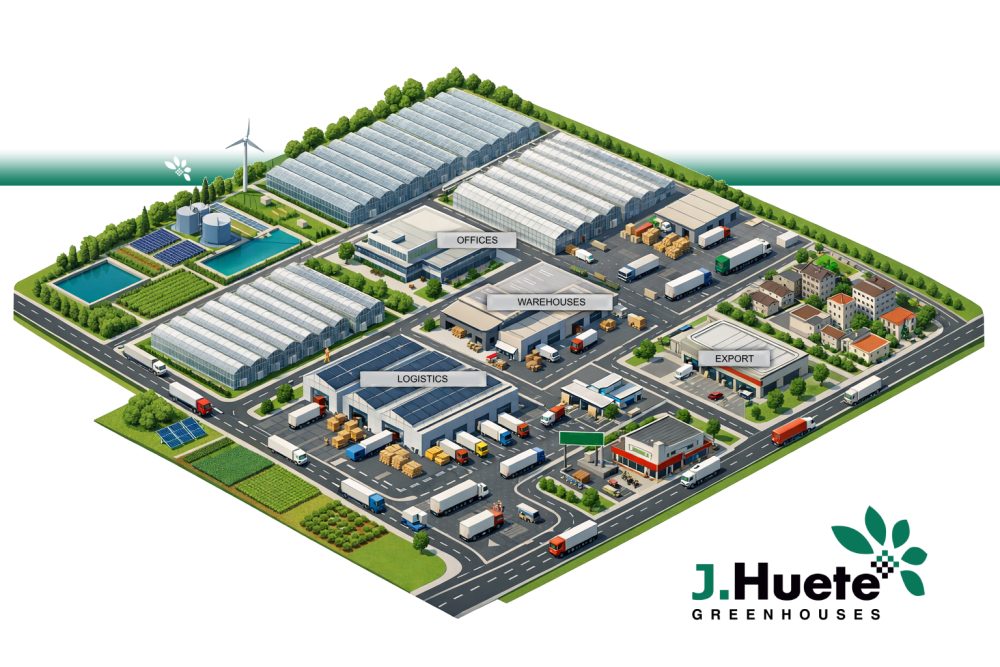
Once the strategic viability and production model are defined, the next stage in designing a profitable Agropark is the conceptualization of the Agropark master plan. This document is not just a technical blueprint—it is the roadmap that organizes productive zones, logistics areas, shared services, and future expansion phases. In a modern agri‑industrial park, the layout of greenhouses, processing facilities, cold‑storage centers, and shared infrastructure must follow principles of operational efficiency, cost reduction, and optimized internal flows.
Productive zoning determines which areas are allocated to greenhouses, which to storage, which to processing, and which to future expansion. A strong master plan anticipates growth without compromising the operability of the initial core. This is crucial for investors seeking scalability without costly redesigns.
In parallel, the design of critical infrastructure determines the project’s resilience. Agropark infrastructure must include energy systems sized for future growth—whether grid‑connected, cogeneration‑based, or powered by renewables. Water management—capture, storage, treatment, and recirculation—is a structural factor in any competitive agri‑industrial development. Drainage must prevent sanitary risks and productivity losses. Internal roadways must allow the smooth movement of goods without interfering with production. And digital connectivity ensures climate control, traceability, and centralized management. Without these foundations, an Agropark loses competitiveness before it even begins.
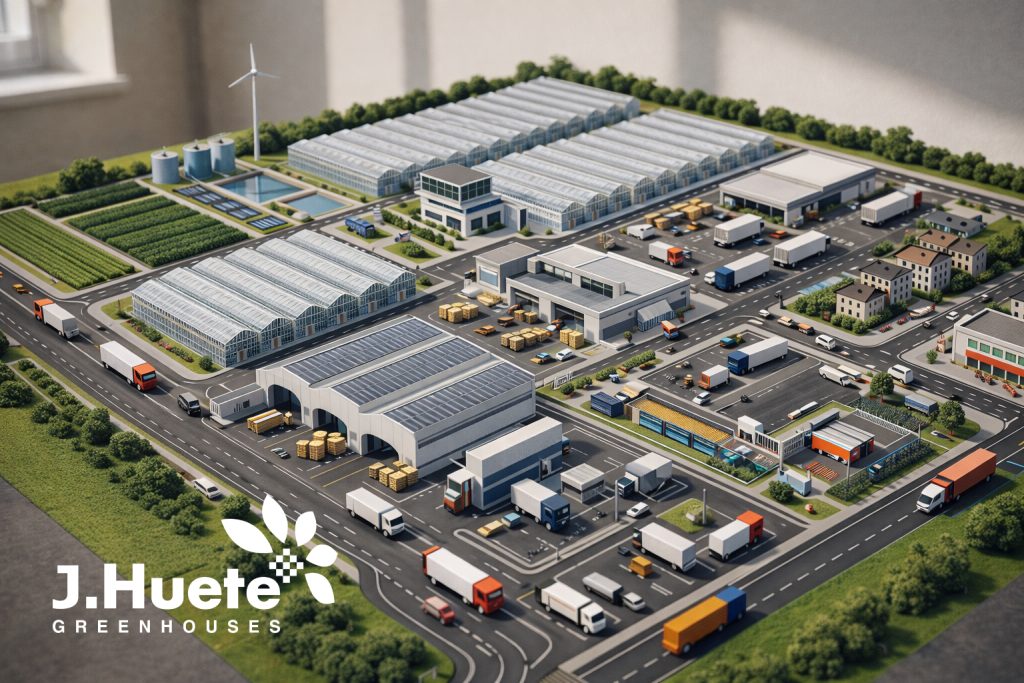
Logistics infrastructure is another decisive pillar. Integrating post‑harvest areas, cold‑chain facilities, consolidation spaces, and export platforms within the park reduces time and costs. It also improves product quality and strengthens negotiating power with international retail chains. A well‑designed Agropark doesn’t just produce—it grades, processes, and ships goods to global standards.
Phased development turns the project into a progressive, controlled investment. The initial core typically includes a critical productive area, basic shared infrastructure, and essential services. From there, expansion proceeds modularly, adding new greenhouse hectares and scaling services according to demand. This staged approach reduces financial exposure and facilitates the entry of new producers.
Finally, the management and governance model determines long‑term stability. A central operator can manage shared services, maintenance, and infrastructure, while producers focus on agricultural operations. Contractual structures must clearly define responsibilities, shared costs, and technical standards.
From a financial perspective, the Agropark becomes a scalable investment platform. It can combine equity, strategic partnerships, institutional funds, and agreements with agricultural operators. When technical design and financial structure are aligned, the Agropark stops being a construction project and becomes a solid agri‑industrial asset—attractive to investors seeking sustainable returns and structured growth.
The decisive phase in any Agropark project is execution. This is where the difference between good planning and a truly profitable asset becomes evident. A turnkey execution model allows full coordination of every stage: conceptual engineering, master plan development, greenhouse manufacturing, construction of critical infrastructure, integration of logistics systems, and operational commissioning.
In large‑scale developments, fragmentation is one of the main risk factors. Multiple suppliers, unclear responsibilities, and lack of technical coordination often lead to cost overruns, delays, and budget deviations. That’s why, in the design and construction of a modern agri‑industrial park, having a single point of responsibility capable of managing the entire project is not just a competitive advantage—it’s an investment safeguard. A holistic approach ensures technical coherence, execution efficiency, and alignment with the business model defined from the start.
Risk management must be embedded from the design phase. Technical risks—such as poor structural choices for Agropark greenhouses, insufficient energy infrastructure, or undersized drainage—can compromise productivity. Financial risks—CAPEX deviations, oversized infrastructure, or poorly planned phases—directly affect returns. Operational risks—failures in logistics, maintenance, or governance—reduce competitiveness against other agri‑industrial hubs.
A professional Agropark design approach incorporates climate scenarios, market projections, technical scalability, and contractual structure from the first strategic sketch. Every construction decision must be backed by economic logic. Every square meter built must respond to a specific productive or commercial need.
In short, an Agropark is no longer just a cluster of greenhouses. It is a long‑term agri‑industrial platform designed to attract investment, integrate technology, optimize resources, and generate sustained profitability. When conceived from the business model, planned with a solid master plan, and executed under a turnkey scheme with rigorous risk control, an Agropark becomes a strategic asset capable of leading the new global agriculture.