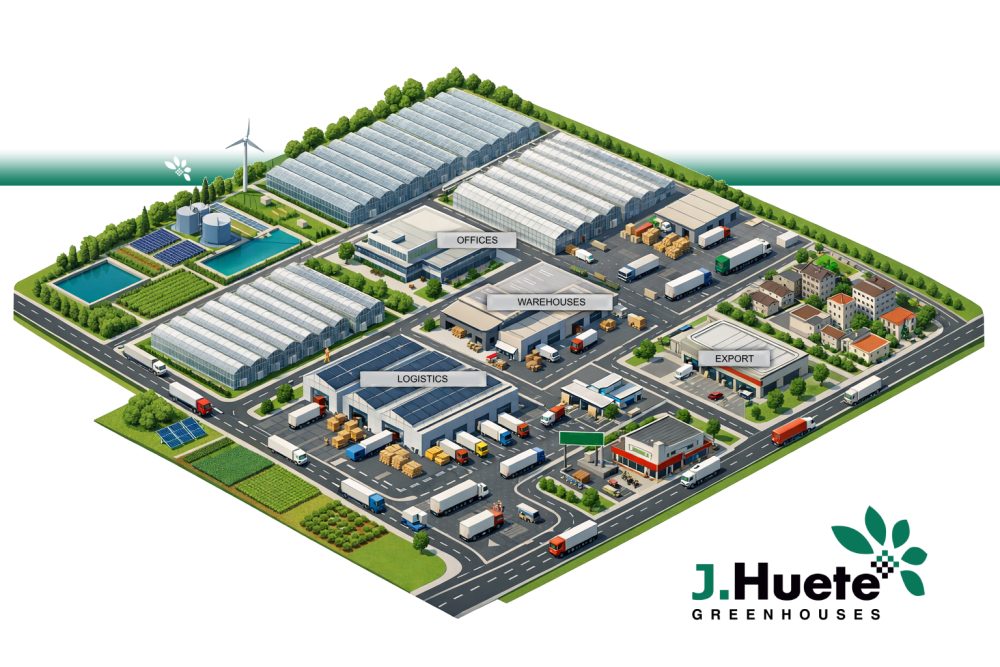
Technical guide to greenhouse production
What is a greenhouse
A greenhouse is a protected cultivation structure designed to create more stable growing conditions than those available in the open field.
Its structure supports a transparent or translucent covering, normally made of plastic or glass, which allows solar radiation to enter while helping protect the crop from rain, wind, abrupt temperature changes and other external conditions.
A professional greenhouse is not simply a physical shelter. Its design may integrate natural or mechanical ventilation, heating, cooling, screening, irrigation, fertigation, lighting, sensors and climate-control systems.
The level of technology required depends on the crop, the local climate, the production calendar, the expected yield, the available resources and the commercial objectives of the grower.
Greenhouse benefits at a glance
| Advantage | Potential contribution to production |
|---|---|
| Greater climate stability | Reduces the crop’s exposure to sudden weather variations. |
| Protection from rain, wind and hail | Helps prevent direct physical damage and operational interruptions. |
| Extended production periods | Makes earlier, later or additional crop cycles possible. |
| Better control of temperature and humidity | Supports more stable plant development when systems are correctly designed. |
| More efficient irrigation and fertigation | Enables precise delivery of water and nutrients. |
| Improved crop uniformity | Creates more consistent conditions across the production area. |
| Greater protection from external pests | Physical barriers and insect screens can reduce pest entry. |
| Better use of agricultural technology | Facilitates automation, sensors, climate computers and crop monitoring. |
| More predictable crop planning | Reduces part of the uncertainty associated with open-field production. |
| Potential for higher productivity | Allows production intensity to increase when climate, crop management and systems are properly coordinated. |
These advantages are potential benefits, not automatic outcomes. A greenhouse must be designed around the actual climate, crop and production strategy of each project.
1. Greater protection from adverse weather
One of the main advantages of a greenhouse is the physical protection it provides against external weather conditions.
The covering and structure can reduce the direct impact of:
-
Heavy rain
-
Strong wind
-
Hail
-
Abrupt temperature changes
-
Excessive solar radiation
-
Dust and airborne particles
This protection can reduce physical crop damage and make production less dependent on short-term weather events.
However, the structure must be calculated for the actual wind, snow and rainfall loads of the project location. A greenhouse designed for one region should not be replicated in another without adapting its dimensions, foundations, drainage capacity, ventilation and structural reinforcement.
2. More stable growing conditions
A greenhouse gives the grower more control over these variables. Depending on the project, conditions can be managed through:
- Roof and side ventilation
- Heating
- Evaporative cooling
- Fogging or humidification
- Dehumidification
- Thermal and shading screens
- Supplemental lighting
- CO₂ enrichment
- Climate computers and sensors
The objective is not to maintain one fixed climate throughout the day. It is to create a controlled and responsive environment adapted to the crop stage and external conditions.
3. Longer and more predictable production periods
Greenhouse cultivation can extend the normal production season of many crops.
Depending on the location and the technology installed, growers may be able to:
- Start production earlier
- Continue harvesting later
- Reduce seasonal interruptions
- Complete more than one crop cycle
- Supply the market during periods of lower availability
- Plan production around commercial programmes
This does not mean that every greenhouse can produce every crop throughout the year. Year-round production depends on whether the structure and its systems can compensate for the limiting conditions of each season.
In cold regions, heating and light may become the principal constraints. In hot regions, ventilation, shading, cooling and humidity management may be more important.
4. More precise irrigation and nutrition
A greenhouse facilitates the integration of precise irrigation and fertigation systems.
Water and nutrients can be supplied according to:
-
Crop type
-
Plant development stage
-
Substrate characteristics
-
Solar radiation
-
Drainage percentage
-
Electrical conductivity
-
Water quality
-
Evaporative demand
This level of control can improve irrigation uniformity and reduce avoidable losses.
In hydroponic and substrate-based cultivation, drainage can also be collected, measured and, when the project permits, treated and recirculated. This provides growers with more information about root-zone conditions while supporting more efficient water and fertiliser management.
The benefit depends on the complete system. A technically advanced greenhouse will not compensate for poor irrigation design, inadequate filtration, unsuitable water quality or an uncoordinated fertigation strategy.
5. More efficient use of water and agricultural inputs
Protected cultivation can improve resource efficiency because water, nutrients and crop-protection measures can be applied more precisely than in many open-field systems.
Potential improvements include:
- Reduced evaporation caused by wind
- More accurate irrigation scheduling
- Localised nutrient delivery
- Collection of drainage
- Greater control of application conditions
- Better monitoring of consumption
- Faster detection of irregularities
The actual saving depends on the crop, climate, growing system, operational practices and technology installed.
Resource efficiency should therefore be treated as a project objective that must be designed and measured, rather than as an automatic result of constructing a greenhouse.
6. Improved crop uniformity and quality
More consistent growing conditions can promote greater uniformity in plant development, flowering, fruit set, size and harvest timing.
This may help growers meet commercial specifications related to:
- Fruit size
- Colour
- Shape
- Firmness
- Appearance
- Harvest schedule
- Batch consistency
Uniformity is particularly important for professional growers supplying supermarkets, exporters, processors, seed companies or other customers with defined quality standards.
The greenhouse contributes to this result, but crop genetics, irrigation, nutrition, climate strategy, plant density, labour and harvest management remain equally important.
7. Greater protection from pests and diseases
A greenhouse creates a physical boundary between the crop and the external environment.
Features such as insect screens, controlled entrances, double doors, hygiene protocols and positive-pressure systems can reduce the risk of pest entry.
The protected environment can also make monitoring and biological control programmes easier to organise.
However, a greenhouse is not automatically free from pests or diseases. Poor ventilation, condensation, excessive humidity, contaminated tools, infected plant material or inadequate hygiene can create serious phytosanitary risks.
Effective protection requires an integrated strategy combining:
- Suitable insect screening
- Controlled access
- Regular monitoring
- Biological or integrated pest management
- Humidity and condensation control
- Crop hygiene
- Correct removal of plant residues
The real advantage is not complete isolation, but the ability to manage crop protection under more controlled conditions.
8. Better integration of technology and automation
A greenhouse provides a suitable platform for integrating agricultural technologies that would be difficult to use with the same precision in open-field cultivation.
These may include:
- Climate computers
- Temperature and humidity sensors
- Radiation sensors
- Irrigation controllers
- Fertigation units
- Drainage measurement
- Crop cameras
- Artificial intelligence tools
- Automated screens
- Heating and cooling controls
- Supplemental lighting
- Data logging and remote supervision
Automation can reduce repetitive manual interventions and help operators make decisions using real-time information.
Technology should nevertheless be selected according to the objectives and management capacity of the operation. Adding more equipment does not necessarily create a better project if the systems are oversized, poorly coordinated or too complex for the production team.
9. Greater production potential per unit of area
When environmental conditions, irrigation, crop density and management are properly coordinated, greenhouse farming can increase production intensity per square metre.
This potential comes from several combined factors:
- Longer growing periods
- Reduced weather-related interruptions
- Better use of vertical space
- More precise plant density
- Improved crop uniformity
- Faster crop development under suitable conditions
- More controlled irrigation and nutrition
The result depends on the production model. A low-technology tunnel, a high-tech plastic greenhouse and a glasshouse do not offer the same level of control, investment or productive potential.
For this reason, productivity should always be evaluated in relation to capital expenditure, operating costs, energy requirements, crop value, market access and technical capacity.
10. More predictable business planning
Agricultural production always involves biological, climatic and market risks. A greenhouse cannot eliminate them, but it can reduce part of the climatic uncertainty.
Greater control can support more reliable decisions regarding:
- Planting dates
- Harvest windows
- Labour planning
- Delivery programmes
- Input purchases
- Production contracts
- Quality specifications
- Expected market periods
This predictability can be especially valuable for growers supplying demanding customers or managing multi-hectare operations.
The business advantage comes from matching the facility to a realistic production and commercial plan.
What determines whether a greenhouse delivers these benefits?
The advantages of protected cultivation depend on the quality of the complete project.
The most important factors include:
Local climate
Historical temperature, humidity, solar radiation, rainfall, wind and snow data must be analysed before defining the structure and climate systems.
Crop requirements
Tomato, cucumber, berries, leafy vegetables, flowers, medicinal plants and seed-production crops have different physiological and operational requirements.
Greenhouse structure
Height, span, roof shape, ventilation area, column spacing, covering and structural strength influence the internal climate and the daily operation of the facility.
Technology level
Heating, cooling, screens, lighting, irrigation, automation and water treatment must be selected according to the limiting factors of the project.
Operational capacity
The performance of the facility depends on the people who manage the crop, interpret the data and maintain the systems.
Commercial objective
The design should reflect the target market, quality requirements, production calendar, crop value and expected return.
A professional greenhouse project begins with these variables. It should not begin by selecting a standard structure and attempting to adapt the production strategy afterwards.
Types of greenhouses and their main advantages
Different greenhouse types offer different levels of protection, control and investment.
Plastic greenhouses
Plastic-covered greenhouses are widely used for professional horticulture. They can provide a strong balance between investment, climate control and adaptability.
Depending on their design, they may incorporate high roof volumes, natural ventilation, double inflated plastic, screens, heating, cooling and automation.
Glasshouses
Glasshouses are designed for projects that require high light transmission, durability and advanced climate control.
They are commonly considered for demanding production programmes and regions where heating, snow loads or long-term structural performance are major design factors.
Gothic multi-tunnel greenhouses
Gothic multi-tunnel structures offer good internal volume and water evacuation, and they can be adapted to many vegetable, fruit and hydroponic production systems.
Their final performance depends on ventilation design, covering, structural loads and installed equipment.
Macrotunnels
Macrotunnels can offer a lower-investment protected cultivation solution for crops such as berries and vegetables.
They provide less climate control than a fully equipped greenhouse but can still protect crops from rain, wind and other external conditions when correctly designed.
High-technology greenhouses
High-tech greenhouses combine the structure with advanced climate, irrigation, automation, water-management and energy systems.
They are appropriate when the crop, climate and business model justify a high degree of environmental control.
Is greenhouse cultivation profitable?
Greenhouse cultivation can be profitable when the project is based on a viable combination of crop, climate, market, technology, investment and operational management.
There is no universal profitability figure.
A project should be evaluated through:
- Expected yield and quality
- Sale price and market access
- Crop cycles per year
- Capital expenditure
- Energy and water costs
- Labour requirements
- Maintenance
- Logistics
- Financing
- Production risk
A greenhouse should not be sold as a guarantee of profitability. It should be designed as a production tool capable of reducing limitations and improving control.
The strongest projects are those in which agronomic objectives, engineering decisions and financial assumptions are developed together before construction begins.
From a greenhouse structure to a complete production project
For professional agricultural companies, the main benefits do not come from the structure alone.
The structure, covering, ventilation, climate systems, irrigation, automation, drainage, electrical installation and operating areas must work as one coordinated facility.
A turnkey approach allows one technical partner to coordinate the different phases of the project, reducing interfaces between suppliers and ensuring that the installed systems respond to the same production strategy.
Greenhouse projects adapted to crop, climate and business objectives
J. Huete Greenhouses designs, manufactures and executes professional greenhouse projects for horticultural companies, growers, investors, seed companies and research organisations.
Each project is developed after analysing:
- Location and climate
- Crop and production system
- Required surface area
- Structural loads
- Ventilation requirements
- Heating and cooling needs
- Irrigation and water quality
- Automation level
- Operational workflow
- Investment and production objectives
The objective is not to add the maximum possible amount of technology. It is to install the appropriate technology for the real requirements of the project.
Frequently asked questions about greenhouse advantages
What is the main advantage of a greenhouse?
The main advantage is the ability to create more controlled and stable growing conditions than in open-field cultivation. This can protect the crop from adverse weather and improve the management of temperature, humidity, irrigation and other production variables.
Can a greenhouse increase crop yield?
A greenhouse can increase production potential by extending the growing period, reducing weather-related interruptions and allowing more precise crop management. The final yield depends on the crop, structure, climate systems, irrigation and operational management.
Can crops be grown throughout the year in a greenhouse?
Some crops can be produced for longer periods or throughout the year, but only when the greenhouse can compensate for the limiting climatic conditions. Heating, cooling, ventilation, lighting or shading may be required depending on the location and season.
Does a greenhouse prevent pests and diseases?
It can reduce exposure to external pests through physical barriers and controlled access, but it does not eliminate phytosanitary risk. Monitoring, hygiene, climate management and integrated pest-control measures remain necessary.
Does greenhouse farming save water?
Greenhouses can support more precise irrigation, reduced wind-related evaporation and drainage collection. Actual water savings depend on the crop, irrigation design, growing system and management strategy.
Are plastic greenhouses or glasshouses better?
Neither option is universally better. Plastic greenhouses often offer a lower initial investment and broad adaptability. Glasshouses can provide high durability and advanced environmental control. The correct choice depends on climate, crop, project scale and business objectives.
What technology does a professional greenhouse need?
The required technology may include ventilation, screens, heating, cooling, irrigation, fertigation, sensors, automation, lighting and water treatment. The selection should be based on the project’s limiting factors rather than on a standard equipment package.
How should a greenhouse project begin?
It should begin with an analysis of climate, crop, site, market, operational capacity and financial objectives. The structure and equipment should then be designed around those requirements.
Planning a professional greenhouse project?
The benefits of greenhouse cultivation depend on the decisions made before construction.
J. Huete Greenhouses develops projects based on the crop, local climate, required production model and expected level of environmental control.

Tell us the location, crop, approximate surface area and production objective. Our technical team will assess the starting requirements of the project.